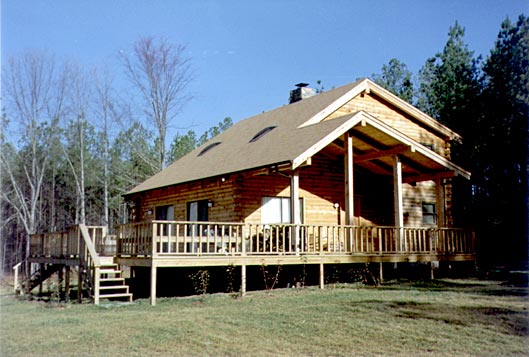
Log cabin homes, log homes, log cabin kits, logs
for log home plans all at WHOLESALE pricing direct
to you.
Log Cabin
Return to a simpler, rustic, life style with a custom designed log cabin
For over a 30 years, Wholesale Log Homes has helped countless
builders and homeowners create beautiful, top-quality log
cabin homes at prices
that log cabin kit sellers simply cannot match. With the right plan in
hand for your log cabin, there is a good chance that you know exactly
what you want to build before you begin shopping different companies.
We offer you the time and money saving option of buying and shipping only
your most important need for your log cabin...logs and timbers. Best of
all, we only ship what you need, thus saving on storage space.
Have you ever dreamed of owning your very own log cabin? As you wish
to return to a simpler, more rustic, "country living" lifestyle
or you are custom building a log cabin, at Wholesale Log Homes, we can
assist you with any of your log purchasing needs...all at wholesale prices.
What sets our log cabin construction apart from others is that you can
take any plan for a log cabin and customize it to your own specifications
and needs.
Wholesale Log Homes has earned a reputation throughout the industry for
supplying superior logs and wood products to customers across the country.
At Wholesale Log Homes you'll find the logs and supplies you need
to build the log cabin of your dreams—easily and affordably! We deal in
the sale of wholesale logs for log building
construction. We can estimate
the cost on the amount of logs and timber materials your
log cabin plan
will require free of charge. Check our prices and compare the savings

Log Homes |
Log
Cabin |
Log
Siding |
Log
Home Kits |
Log
Cabin Home |
Log
Cabin Kits
Log Home Plans |
Log House |
Log Home Builder |
Logs |
Log Cabin Plans
|
Log
Home Energy Efficiency
Frequently
Asked Questions
| Letter
to Consumers
Category
Log Cabins
Wikipedia
Encyclopedia Link http://en.wikipedia.org/wiki/Log_cabins
Encyclopedia Article A log cabin is a house built from logs. It is a fairly simple type of log house. A distinction should be drawn between the
traditional meanings of "log cabin" and "log house." Historically most "Log cabins" were a simple one- or 1˝-story structures, somewhat impermanent, and less finished or less architecturally sophisticated. A "log cabin" was usually constructed with round
rather than hewn, or hand-worked, logs, and often it was the first generation home building erected quickly for frontier shelter.
Log cabins were built from logs laid horizontally and interlocked on the ends with notches (British English cog joints). Some log
cabins were built without notches and simply nailed together, but this was not as structurally sound. Modern building methods allow
this shortcut.
Details of cabin corner joint with squared off
logs. The most important aspect of cabin building is the site upon which the cabin was
built. Site selection was aimed at providing the cabin inhabitants with both sunlight and drainage to make them better able to cope
with the rigors of frontier life. Proper site selection placed the home in a location best suited to manage the farm or ranch. When
the first pioneers built cabins, they were able to "cherry pick" the best logs for cabins. These were old-growth trees with few limbs
(knots) and straight with little taper. Such logs did not need to be hewn to fit well together. Careful notching minimized the size of
the gap between the logs and reduced the amount of chinking (sticks or rocks) or daubing (mud) needed to fill the gap. The length of
one log was generally the length of one wall, although this was not a limitation for most good cabin builders.
Decisions had to be made about the type of cabin. Styles varied greatly from one part of the US to another: the size of the cabin, the
number of stories, type of roof, the orientation of doors and windows all needed to be taken into account when the cabin was designed.
In addition, the source of the logs, the source of stone and available labor, either human or animal, had to be considered. If timber
sources were further away from the site, the cabin size might be limited.
Cabin corners were often set on large stones; if the cabin was large, other stones were used at other points along the sill (bottom log).
Since they were usually cut into the sill, thresholds were supported with rock as well. These stones are found below the corners of many
18th-century cabins as they are restored. Cabins were set on foundations to keep them out of damp soil but also to allow for storage or
basements to be constructed below the cabin. Cabins with earth floors had no need for foundations.
Map and Origin Link View Map
Verbal History
The modern version of a log cabin is the log home, which is a house built usually from milled logs. The logs are visible on the exterior and
sometimes interior of the house. These cabins are mass manufactured, traditionally in Scandinavian countries and increasingly in eastern Europe. Squared milled logs are precut for easy assembly. Log homes are popular in rural areas, and even in some suburban locations. In many resort communities in the American West, homes of log and stone measuring over 3,000 sq ft (280 m2) are not uncommon. These "kit" log homes are one of the largest consumers of logs in the Western United States.
In Europe, modern log cabins are often built in gardens and used as summerhouses, home offices or as an additional room in the garden. Summer houses and cottages are often built from logs in northern Europe.
|