
How Energy Efficient is a Log Home?
From www.loghomes.org article titled The Energy Performance of Log Homes
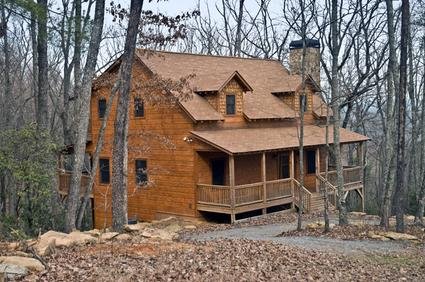 The log home is a fundamental construction concept. Some of the oldest occupied structures in North America are log buildings, indicating their fundamental durability when properly designed and constructed. Modern manufacturing methods are bringing new technologies to bear in making log homes increasingly energy efficient and even more long lasting.
There is a large engineering technical literature supporting the validity of granting performance adjustments or “credits”, as they are sometimes called, for thermal mass in structural walls of buildings. When the annual heating and cooling benefits of mass are analyzed for single-family homes, it is important to realize that the overall assessment of the net benefits should be the focus of the study. In some cases increased energy use may occur during one part of the year (days, months) versus another period, while net-net the building may be shown to use less overall space conditioning energy on an annual basis.
For homes these whole-building performance benefits fall into a range of 2.5% to over 15% for most US climates. This means, a log home having 30% to 40% lower numerical R-value will provide equivalent performance for heating and cooling when using numerically lower steady state R-values in its walls than will a stick-framed home of otherwise identical design.
Exceptions are areas with especially cold or especially hot weather, where the benefits of wall heat capacity are reduced according to engineering studies. These are extreme climates where thermal mass has little or no benefit, such as those with greater than about 8,500 Heating Degree Days (HDD) and those with very high Cooling-Degree Hours (CDH74).
Log homes are constructed of natural and renewable materials that are inherently more environmentally efficient than processed lumber in construction. Using logs can be a “green building” method especially when the timber is produced locally (typically the case), or the log home producer uses wind or fire-killed timber as the log source. There are also Manufactured log-type wall systems of composite design where smaller dimensional wood and insulating material are combined to provide a log-like construction unit.
Another inadvertent environmental benefit of a log home building is that in the distant future, when the log home is demolished or deconstructed for its component parts, the logs will provide value as a source of quality timber for producing other lumber and wood products unlike stick frame construction which is often demolished and shipped direct to landfills.
All told, the log home has shown to be a completely energy efficient, durable, and environmentally useful alternative to a typical stick frame construction. Technical progress will continue to evolve log homes that are even better performers. Both consumers and the environment will benefit from the increasing recognition of log homes as green and efficient dwellings.